Key takeaways
- Sort images into two piles: those that must be true, and those that only set a mood.
- AI suits backgrounds, variations, ad tests and short video loops.
- A real shoot suits product accuracy, people, food and regulated claims.
- Get written permission for any likeness and check platform rules on synthetic media.
- Shoot the hero product once, then generate scenes around it.
Should a brand use AI product photography or a real shoot?
Most brands should use both, for different jobs. AI image and video tools can now produce convincing scenes quickly, and that changes the economics of marketing content. They do not change the fact that a customer who receives a product expects it to look like the picture.
So the useful question is not which is better. It is which job each image has to do. A picture that sells the exact product needs to be true. A picture that sets a mood around the product can be invented. Sort your images into those two piles and most of the decision makes itself.
Where does AI imagery work well?
AI works well where the image is about atmosphere, variety or speed, and not about precise detail. We see four uses that hold up in practice.
- Lifestyle backgrounds. Place a real product photo into a kitchen, a beach, a studio set or a seasonal scene without building the set.
- Variations at volume. Different colors of a room, different seasons, different aspect ratios for each ad placement.
- Ad testing. Generate ten concepts, run small budgets against each, and only commission a full production for the winner.
- Short video loops. Subtle motion for social posts, product page headers and story formats, where a few seconds of movement is the point.
Where does a real shoot still win?
A real shoot wins wherever accuracy, trust or physical reality matters. Generated images drift: a logo is slightly wrong, a stitch pattern changes, a bottle label gains a letter. That is a minor annoyance in a background and a real problem on a product page.
Here is where we would still book a studio.
- True product accuracy. Color, texture, scale, fit and finish are what customers pay for, and returns follow when the photo oversells.
- People. Hands, faces and bodies are still the weak point of many generated images, and viewers sense when something is off even if they cannot say why.
- Food and drink. Appetite depends on believable texture, steam, condensation and portion size, and the dish in the picture must match what is served.
- Regulated claims. Supplements, cosmetics, medical and financial products can face rules about what imagery implies. A generated before and after is a risk you do not want to explain.
- Hero images. The main shot on your homepage and top product pages deserves the real thing.
What about disclosure and likeness rights?
Disclosure and likeness are where brands get into trouble, so decide your policy before you publish. Rules differ by country, platform and industry, and they are changing, so check current requirements with a lawyer rather than trusting a blog post, ours included.
A few points are safe to act on. Ad platforms and marketplaces have their own policies on synthetic media, and some ask you to label generated content, so read the current ones before you launch a campaign. Never generate a realistic image of a real person, or a lookalike of one, without written permission. If you use a model or influencer, your contract should say plainly whether their likeness can be used in AI-generated work, and for how long.
Keep records as you go. Note which images were generated, which tool and settings produced them, and who approved each one. If a platform asks questions later, or a customer complains, a simple log of what is real and what is generated saves a long afternoon of guessing. The same goes for the source photos you feed in: confirm you own the rights to them, and that a freelance photographer's contract allows reuse in generated work.
Beyond the rules, there is trust. If a shopper discovers that the happy customer in your ad does not exist, it costs you more than the saved shoot. Honest labeling is cheaper than an apology.
What does a hybrid workflow look like?
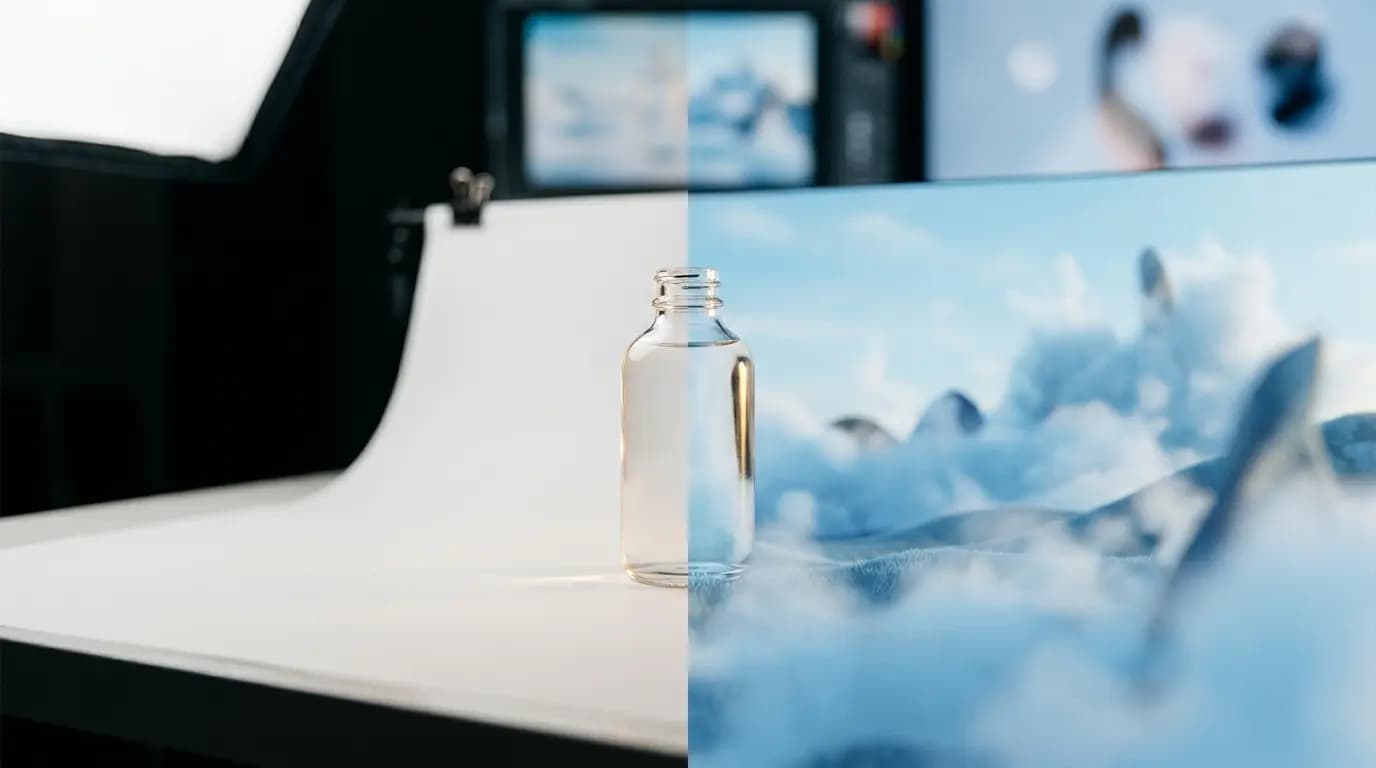
A hybrid workflow means you shoot the hero product once, properly, and generate everything around it. This gives you real accuracy where it counts and cheap variety where it helps.
- 1Shoot each product on a clean background from every useful angle, in consistent light, with a color reference card in the frame.
- 2Retouch and approve those images. They become your source of truth.
- 3Generate scenes and backgrounds around the real product cut-outs, never replacing the product itself.
- 4Check every generated image against the real product for logo, color, proportions and label text before it goes anywhere.
- 5Test the best performers in small ad budgets, then promote the winners to a real, fully produced shoot if the numbers justify it.
What goes wrong when brands rely on AI images alone?
The common failure is a catalog that looks polished and slightly false. Each image is fine alone, but together they drift: the same bag has a different strap length in three scenes, the shadows disagree about where the light is, and the product page shows a finish the real item does not have. Customers feel that mismatch even when they cannot name it, and it shows up later as returns and reviews that say it looked different online.
A second failure is the sameness problem. When every competitor uses the same tools with similar prompts, their feeds begin to look alike, and a brand with a real point of view gets lost. A real shoot gives you something the tools cannot copy: your actual product, your actual people and your own art direction.
A third is process. Generated images still need a person to review each one, and that review is real work. Budget for it, write a short checklist (logo, color, proportions, label text, hands), and make someone responsible for saying no. The tools are fast. The approval step is what keeps the output honest.
How should you decide for your own catalog?
Start with returns and complaints. If customers already say the product looks different from the photos, put your budget into real photography. If your problem is a lack of fresh creative for ads, put it into AI scenes built on real product shots.
A practical test: print your ten best-selling products on one page, then ask a colleague who has never seen them to point out which pictures look off. If they spot problems in the generated ones within a minute, you have your answer for those products. Use the same exercise before any big campaign, since fresh eyes catch what the team has stopped noticing.
Our commercial photography and video team can run the real shoot and the generated scenes as one pipeline, so the lighting and brand style match. If you also need help with how the images are used across channels, our digital marketing and branding services cover that. For a decision on your own catalog, tell us what you sell and we will suggest which images deserve a camera.
Questions people also ask
Not for images that need to show the exact product. It can replace much of the background, set and variation work. Most brands get better results keeping a real photographic source and using AI around it.
Requirements vary by platform, country and industry, and they are changing. Check the current rules for each channel you advertise on, and ask a lawyer about your market. Labeling clearly is a sensible default.
It can be, mainly for volume and testing. Review time still counts, since every image needs a human check against the real product. The saving shows up most when you need many scene variations from one shoot.
Phone photos can work as a starting point if the lighting is even and the product is sharp. For your hero images, a proper shoot is worth the money, because everything generated afterward inherits the quality of the source.
Related services
Written by the Trennect engineering team, Ahmedabad. Published November 7, 2026.